Fast Fourier Transform
In this article I attept to explain the principles of the fast fourier transform (FFT) and develop in incremental steps an implementation in common lisp.
Introduction
The FFT is an algorithm for computing the discrete fourier transform (DFT) of an
array of values that is meant to be faster than the usual naive implementation.
Instead of having the usual  behaviour it is an
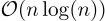 algorithm.
Derivation
To derive the FFT we first consider the definition of the DFT
Let  be an array of N, possible complex, numbers such that
 for some integer
  . The DFT of
  is an array of
the same length
is an array of
the same length  defined as:
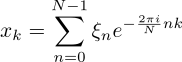 (1)
(1)
A possible implementation of this in code would be something like the following:
(defun dft (x)
  "Naive discrete fourier transform, not fft"
  (flet ((transform (k)
           (loop :with i = (complex 0 1)
                 :for n :below (length x)
                 :sum (* (aref x n) (exp (- (/ (* 2 pi i k n) (length x))))))))
    (map-seq-iota #'transform (length x))))
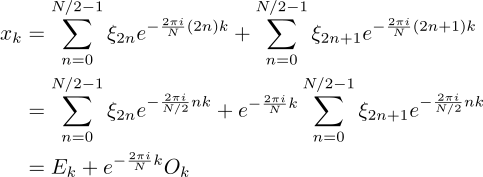
But we can do a lot better in terms of performance. To this end we first split the sum (1) into even and odd members
 (2)
(2)
Where  and
and  themselves are FFTs of a smaller array each.
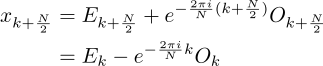
Furthermore notice how thanks to the cyclic nature of the complex exponential
function it is possible to half the number of computations:
themselves are FFTs of a smaller array each.
Furthermore notice how thanks to the cyclic nature of the complex exponential
function it is possible to half the number of computations:
 (3)
(3)
Thus,
 (4)
(4)
Implementing the FFT
With the reduction identities we derived for the FFT a preliminary implementation could be:
(defun fft (sequence)
  (labels
      ((fft-step (n step offset)
         (let ((ret (make-array n)))
           (if (= n 1)
               (setf (aref ret 0) (aref sequence offset))
               (loop
                 :with n2 = (/ n 2)
                 :with ek = (fft-step n2 (* 2 step) offset)
                 :with ok = (fft-step n2 (* 2 step) (+ offset step))
                 :for k :below n2
                 :for c = (exp (- (/ (* 2 pi (complex 0 1) k) n)))
                 :do
                    (setf (aref ret k) (+ (aref ek k) (* c (aref ok k)))
                          (aref ret (+ k n2)) (- (aref ek k) (* c (aref ok k))))))
           ret)))
    (fft-step (length sequence) 1 0)))
The function fft-step needs to be able to access both even and odd terms,
for this we use the step and offset arguments. step indicate the
distance between consecutive elements of the input to the fft. If we wanted to
compute the FFT of the even terms, this distance would be 2. For the fft inside
this outer fft of the even entries we also want to split further into even an
odd members, this step needs to be 4 and so on. offset represents how
many elements must be skipped until the first element of the subarray.
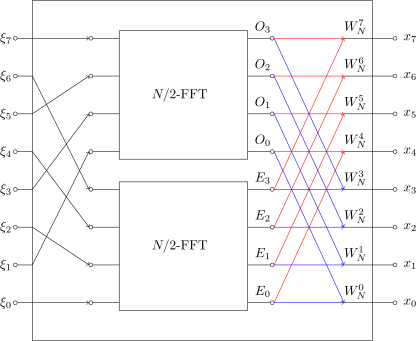
Notice that we are allocating in each step a new array to return. The FFT can
however be computed with a single array allocation. For that we store the values
of  in the first half of the return array and the values of
  in the second half. Finally we use the so called "butterfly" operations to
compute the final result.
in the second half. Finally we use the so called "butterfly" operations to
compute the final result.
(defun fft* (sequence)
  (let ((result (make-array (length sequence))))
    (labels ((fft-step (n step offset roffset)
               (if (= n 1)
                   (setf (aref result roffset) (aref sequence offset))
                   (let ((n2 (/ n 2)))
                     (fft-step n2 (* 2 step) offset roffset)                 ; e_k
                     (fft-step n2 (* 2 step) (+ offset step) (+ roffset n2)) ; o_k
                     (loop :for k :below n2
                           :for j = (+ roffset k)
                           :for c = (exp (- (/ (* 2 pi (complex 0d0 1d0) k) n)))
                           :for ek = (aref result j)
                           :for ok = (aref result (+ j n2))
                           :do
                              (setf (aref result j)        (+ ek (* c ok))
                                    (aref result (+ j n2)) (- ek (* c ok))))))))
      (fft-step (length sequence) 1 0 0)
      result)))
fft* is still a recursive function and as such the call stack will grow as
 . As a last step let us introduce a last iterative
version of our function.
. As a last step let us introduce a last iterative
version of our function.
(defun fft (sequence)
  (flet ((reverse-bits (bits n)
           (loop :for k :below n
                 :summing (if (logbitp k bits)
                              (ash 1 (- n k 1))
                              0))))
    (let* ((n (length sequence))
           (result (make-array n))
           (nbits (logcount (1- n))))
      (dotimes (i n)
        (setf (aref result i) (aref sequence (reverse-bits i nbits))))
      (do ((q 1 (1+ q)))
          ((>= q (1+ nbits)))
        (let ((b (ash 1 (1- q))))
          (dotimes (i (ash n (- q)))
            (dotimes (j b)
              (let ((even (aref result (+ (ash i q) j)))
                    (odd (aref result (+ (ash i q) j b)))
                    (c (exp (- (/ (* 2 pi (complex 0 1) j) (* b 2))))))
                (setf (aref result (+ (ash i q) j)) (+ even (* c odd)))
                (setf (aref result (+ (ash i q) j b)) (- even (* c odd))))))))
      result)))
reverse-bits is responsible for reordering the initial array the same way
the deepest call of fft-step in the recursive version would.
There are still many optimizations that could be made to speed up our code, like twiddle factors, cache optimizations, further prime factors and many others. But this goes beyond the scope I planned for this article. Many would probably be also beyond the scope of my current abilities.
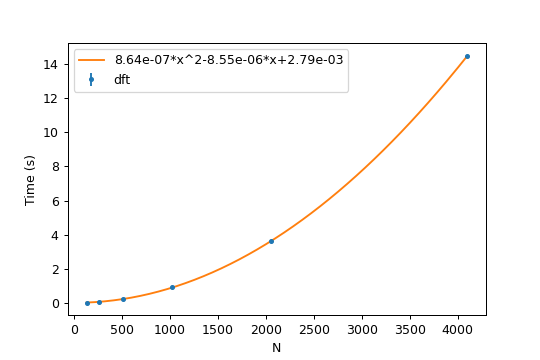
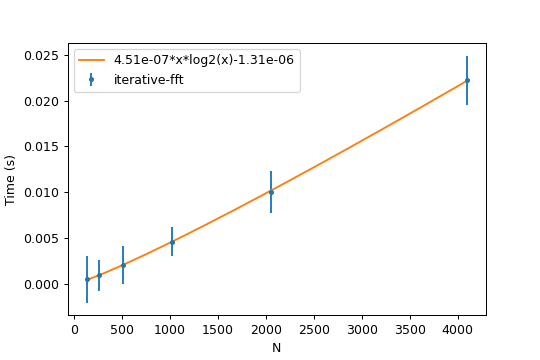
Asymptotic performance
Thoughout this article I claimed that the performance of the FFT scales like
 instead of the usual
  performance of the naive DFT. While this can be proven by analizing the provided
source code, I decided to run some meassurements and compare them with their
respective big-O functions.
performance of the naive DFT. While this can be proven by analizing the provided
source code, I decided to run some meassurements and compare them with their
respective big-O functions.